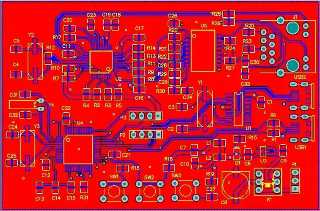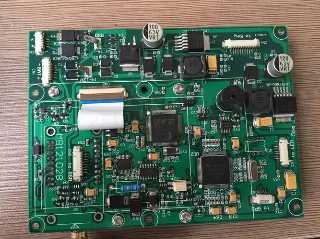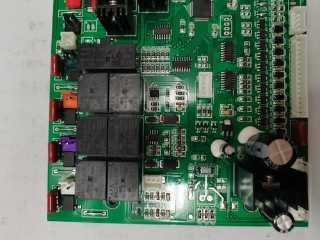
MICrosemi公司的SmartFusion2 SoC FPGA是低功耗FPGA器件,集成了第四代基于闪存FPGA架构,166MHz ARM Cortex-M3处理器和高性能通信接口,是业界最低功耗,最可靠和最高安全的可编逻辑解决方案.高速串行接口包括PCIe,10Gbps附加单元接口(XAUI)/XGMII)以及SerDes通信,主要用在数据安全,马达控制,系统管理,工业自动化,高速串行I/O应用,PCIe,,SGMII以及用户定义的串行接口.本文介绍了SmartFusion2 SoC FPGA主要特性,框图和芯片布局图,以及SmartFusion2 SoC FPGA评估板M2S090TS-EVAL-KIT主要特性,框图,电路图,材料清单和PCB设计图.
MICrosemi SmartFusion®2 SoC FPGAs integrate a fourth-generation, flash-based FPGA fabric, an ARMCortex-M3 processor, and high-performance communications interfaces on a single chip. ThESMartFusion2 family is the industry’s lowest-power, most reliable, and highest-security progRAMmablelogic solution.
SmartFusion2 SoC FPGAs offer up to 3.6X the gate density and up to 2X the performance of previousflash-based FPGA families, and also include multiple memory blocks and multiply-accumulate blocks forDSP processing. The 166-MHz ARM Cortex-M3 processor is enhanced with an embedded tracemacrocell (ETM), a memory protection unit (MPU), an 8-KB instruction cache, and additional peripherals,including controller area network (CAN), gigabit Ethernet, and a high-speed universal serial bus (USB).
High-speed serial interfaces include PCI Express (PCIe), 10-Gbps Attachment Unit Interface(XAUI)/XGMII extended sublayer (XGXS), plus native serialization/deserialization (SerDes)communication. The DDR2/DDR3 memory controllers available in the devices provide high-speedmemory interfaces.
SmartFusion2 SoC FPGA主要特性:
The following sections list the features of SmartFusion2 SoC FPGAs.
Reliability
• Single event UPSet (SEU)-immune
• Zero FIT FPGA configuration cells
• Junction temperature
• 125 °C—military temperature
• 100 °C—industrial temperature
• 85 °C—commercial temperature
• 125 °C—automotive
• Single error correct double error detect (SECDED) protection on the following:
• Ethernet buffers
• CAN message buffers
• Cortex-M3 embedded scratch pad memory (eSRAMs)
• USB buffers
• PCIe buffer
• DDR memory controllers with optional SECDED modes
• Buffers implemented with SEU resistant latches on the following:
• DDR bridges (MSS, MDDR, and FDDR)
• Instruction cache
• MMUART FIFOs
• SPI FIFOs
• NVM integrity check at power-up and on demand
• No external configuration memory required—instant-on, retains configuration when powered off
Security
• Design security features (available on all devices)
• Intellectual property (IP) protection through unique security features and use models new to thePLD industry
• Built-in CRI DPA pass-through license fROM RAMbus Cryptography Research
• Encrypted user key and bitstream loading, enabling programming in less-trusted locations
• Supply-chain assurance device certificate
• Enhanced anti-tamper features
• Zeroization
• Data security features
• Non-deterministic random bit generator (NRBG)
• User cryptographic services (AES-256, SHA-256, and elliptical curve cryptographic (ECC)engine)
• User physically unclonable function (PUF) key enrollment and regeneration
• CRI pass-through DPA patent portfolio license
• Hardware firewalls protecting microcontroller subsystem (MSS) memories
Low Power
• Low static and dynamic power
• Flash*Freeze mode for fabric
• Power as low as 13 mW/Gbps per lane for SerDes devices
• Up to 50% lower tOTAl power than competing SoC devices
High Performance
• Efficient 4-input look-up tables (LUTs) with carry chains for high performance and low power
• Up to 236 blocks of dual-port 18-Kbit SRAM (LSRAM) with 400 MHz synchronous performance (512
× 36, 512 × 32, 1 Kb × 18, 1 Kb × 16, 2 kbit × 9, 2 Kb × 8, 4 Kb × 4, 8 Kb × 2, or 16 Kb × 1)
• Up to 240 blocks of three-port 1-Kb SRAM with two read ports and one write port (micro SRAM)
• High-performance DSP signal processing
• Up to 240 fast mathblocks with 18 × 18 signed multiplication, 17 × 17 unsigned multiplicationand 44-bit accumulator
Microcontroller Subsystem
• Hard 166-MHz 32-Bit ARM Cortex-M3 processor
• 1.25 DMIPS/MHz
• 8 Kbyte instruction cache
• Embedded trace macrocell (ETM)
• Memory protection unit (MPU)
• Single cycle multiplication, hardware divide
• JTAG debug (4 wires), serial wire debug (SWD, 2 wires), and serial wire viewer (SWV)
interfaces
• 64 KB embedded SRAM (eSRAM)
• Up to 512 KB embedded nonvolatile memory (eNVM)
• Triple-speed Ethernet (TSE) 10/100/1000 Mbps MAC
• USB 2.0 high speed on-the-go (OTG) controller with ULPI interface
• 2.0B-compliant CAN controller, conforms to ISO11898-1, 32 transmit and 32 receive buffers
• Two SPI ports, two I2C ports, and multi-mode UARTs (MMUART) peripherals
• Hardware-based watchdog timer
• One general-purpose 64-bit (or two 32-bit) timer(s)
• Real-time calendar/counter (RTC)
• DDR bridge (4-port data R/W buffering bridge to DDR memory) with 64-bit AXI interface
• Non-blocking, multi-layer AHB bus matrix allowing multi-master scheme supporting 10 masters and7 slaves
• Two AHB-Lite/APB3 interfaces to FPGA fabric (master/slave-capable)
• Two DMA controllers to offload data transactions fROM the Cortex-M3 processor
• 8-channel peripheral DMA (PDMA) for data transfer between MSS peripherals and memory
• High-performance DMA (HPDMA) for data transfer between eSRAM and DDR memories
Clocking Resources
• Clock sources
• Up to two high precision 32 KHz to 20 MHz main crystal oscillator
• 1-MHz embedded RC oscillator
• 50-MHz embedded RC oscillator
• Up to eight clock conditioning circuits (CCCs) with up to eight integrated analog PLLs
• Output clock with eight output phases and 45° phase difference (multiply/divide and delaycapabilities)
• Frequency: 1 MHz to 200 MHz input, 20 MHz to 400 MHz output
High-Speed Serial Interfaces
• Up to 16 SerDes lanes, each supporting:
• XGXS/XAUI extension (to implement a 10-Gbps (XGMII) Ethernet PHY interface)
• Native EPCS SerDes interface that facilitates implementation of serial rapidIO (SRIO) in fabricor an SGMII interface to the Ethernet MAC in MSS
• PCI express (PCIe) endpoint controller
• ×1, ×2, and ×4 lane PCI express core
• Maximum payload size of up to 256 bytes
• 64-bit/32-bit AXI interface and 64-Bit/32-Bit AHB master and slave interfaces to the applicationlayer
High-Speed Memory Interfaces
• Up to two high-speed DDRx memory controllers
• MSS DDR (MDDR) and fabric DDR (FDDR) controllers
• Supports LPDDR/DDR2/DDR3
• Maximum 333 MHz DDR clock rate
• SECDED enable/disable feature
• Supports various DRAM bus width modes, ×8, ×9, ×16, ×18, ×32, ×36
• Supports command reordering to optimize memory efficiency
• Supports data reordering, returning critical word first for each command
• SDRAM support through the SMC_FIC and additional soft SDRAM memory controller
Operating Voltage and I/Os
• 1.2 V core voltage
• Multi-standard user I/Os (MSIO/MSIOD)
• LVTTL/LVCMOS 3.3 V (MSIO Only)
• LVCMOS 1.2 V, 1.5 V, 1.8 V, 2.5 V
• DDR (SSTL2_1, SSTL2_2)
• LVDS, MLVDS, Mini-LVDS, RSDS differential standards
• PCI
• LVPECL (receiver only)
• DDR I/Os (DDRIO)
• DDR2, DDR3, LPDDR, SSTL2, SSTL18, HSTL
• LVCMOS 1.2 V, 1.5 V, 1.8 V, 2.5 V
• Market-leading number of user I/Os with 5G SerDes